How to Improve Candidate Experience: A 5-Part Framework
By the Role.so team. Published 24 August 2026.
This guide is for recruiters, hiring managers and talent acquisition teams improving the hiring process from first contact to offer or rejection. It draws on applicant-reaction research, public benchmark reports and product work on candidate-facing recruitment pages.
Candidate experience is the overall perception people form of an employer through the hiring process, from a job page, referral or outreach message to application, interviews, offer or rejection, and relevant preboarding. Improve it by making interactions clearer, fairer, faster and easier to navigate.
Key takeaways
- Make the role clear and realistic before asking for commitment.
- Explain the process, criteria, timeline and next action early.
- Personalise only when it adds truthful, job-relevant context.
- Assign ownership for updates and feedback.
- Make every next step easy and accessible.
- Measure candidate perception alongside behavioural funnel data.
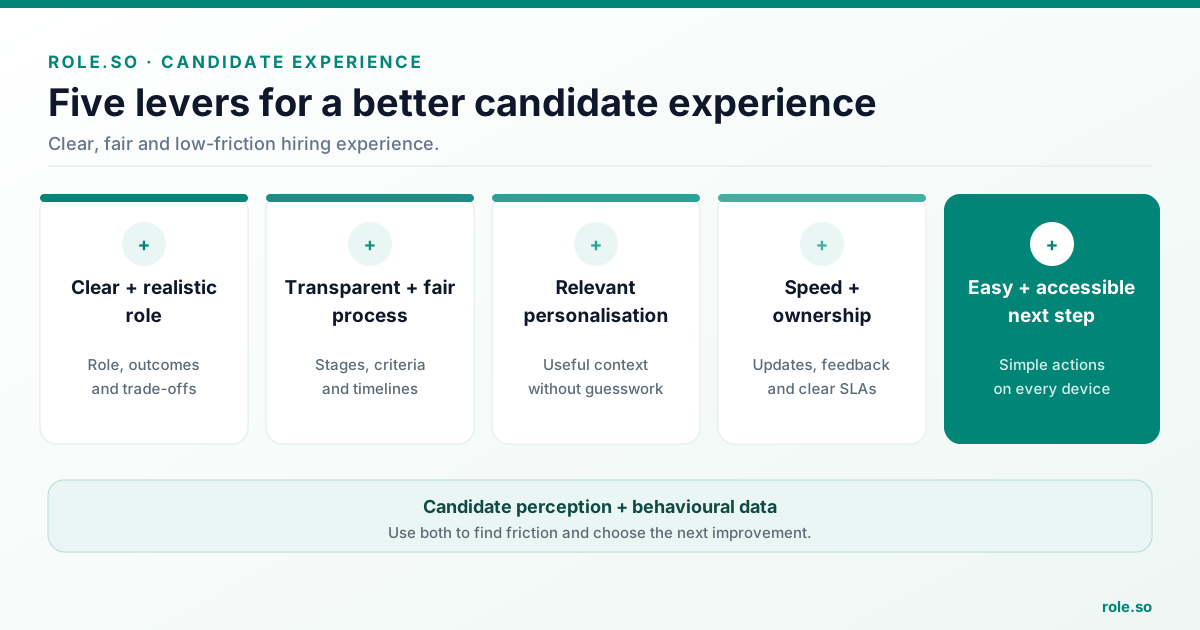
Figure 1. Five levers for a better candidate experience.
What candidate experience means
Candidate experience extends beyond the application form. It includes job posts, careers pages, recruiter messages, assessments, interviews, decisions and preboarding where relevant.
The candidate journey is the sequence of touchpoints. Candidate experience is how people perceive them. A journey map shows where interactions happen; an experience review asks whether each touchpoint makes the participants, preparation, timing and next update clear.
This guide covers first exposure through offer or rejection, plus preboarding for hired candidates. LinkedIn identifies pre-application, application, interview and post-interview stages; Glassdoor likewise covers job posting through offer or rejection (LinkedIn; Glassdoor).
Research on applicant reactions treats the experience as more than a sequence of touchpoints. A review of 145 studies links perceived fairness, anxiety and motivation with attitudes, job intentions and recommendations, while Miles and McCamey connect recruitment interactions, candidate experience and employer brand (McCarthy et al.; Miles and McCamey).
The Role.so Five-Part Candidate Experience Framework
The framework is built around five practical levers.
1. Make the role clear and realistic
Candidates should understand what the role is for, what they own and what success looks like. A long responsibility list is not enough.
Give candidates enough context to decide whether the role fits:
- the main outcomes and first priorities
- the team, manager and working relationships
- the company context and reason the role exists now
- the salary range, contract and meaningful benefits
- the location, working pattern and practical constraints
- the difficult or less attractive parts of the role
A candidate information pack can complement a job description. The job description defines the role and requirements; the pack adds context for self-selection. Realistic detail reduces surprises later.
Treat the candidate-facing page as a continuation of the job post, referral or outreach message that brought someone there. If a specific message leads to a generic page, the context is lost at the moment the candidate evaluates the opportunity.
This aligns with realistic job previews, which the U.S. Office of Personnel Management describes as giving applicants accurate information before an offer.
2. Make the process transparent and fair
Process uncertainty makes hiring feel longer. Candidates want to know the stages, who they will meet, whether an assessment is required, how it will be used and when a decision is expected.
Explain it before candidates invest significant time: include stage purpose, criteria, preparation, timeline and next action. If it may change, say what is fixed and what depends on the role or team.
Fairness is part of candidate experience. Use a consistent interview structure and standards for comparable candidates. Explain assessment use, decision ownership, reasonable adjustments and, where relevant, data use and retention.
Transparency also includes compensation and working arrangements. Sharing constraints early may reduce continuation, but it can improve alignment among the candidates who proceed.
3. Personalise for relevance, not decoration
Personalisation helps when it explains why an opportunity may fit a candidate's experience, goals or constraints. A name inserted into a generic page is not personalisation.
For inbound hiring, relevance may mean showing the role in team, location or work-pattern context. For outbound hiring, it may connect the opportunity to a specific part of a candidate's background.
Keep the boundary clear: do not imply selection, infer sensitive information or make promises the team cannot honour. Good personalisation reduces interpretation work without compromising honesty.
4. Improve speed, ownership and feedback
Silence is also communication. Without status, candidates fill gaps with assumptions.
Assign an owner and response time for each transition. Confirm applications or expressions of interest, explain delays, close the loop with candidates who will not progress and give specific feedback when the process can support it.
Speed does not mean rushing decisions. Make waiting visible and track time to first response, time in each stage, time to decision and updates sent within the promised window.
5. Make every next step easy and accessible
Every interaction should make the next action obvious: apply, reply, book a call, complete an assessment, ask a question or decline. Candidates should not have to search for it.
Reduce unnecessary friction:
- keep forms and instructions focused on what is needed
- make the experience usable on mobile devices
- provide accessible text, controls and alternatives
- avoid asking for information the candidate already supplied
- offer one clear next step and a visible way to ask for help
The right next step may be a conversation, more information or a respectful decline. A candidate-friendly process supports all three.
Why candidate experience deserves attention now
Candidate experience can influence whether people continue, respond, attend, accept, reapply or recommend the organisation. It also reveals avoidable work for candidates and recruiters.
Research provides context, not proof that one tactic produces a specific outcome. SHRM's 2026 Talent Trends research found that nearly 70% of HR professionals still faced challenges recruiting for full-time roles (SHRM).
Its 2025 research provides more detail on candidate behaviour: 69% of organisations had difficulty filling full-time roles, while 41% said candidates were ghosting them during the interview process (SHRM).
CareerPlug's 2025 report found that 26% of job seekers declined an offer because of poor candidate experience. It also found that 28% prioritised clearer job information, while 26% wanted greater compensation and benefits transparency (CareerPlug).
Survale's 2025 CandE Benchmark Research draws on more than 66,000 completed candidate surveys collected between January 31 and August 31, 2025, with 110 organisations registered to participate worldwide. Its dominant negative theme was lack of communication, ghosting and no follow-up. It reported that 31% of North American candidates did not hear back from employers for one to two months or longer after applying, while 56% received no feedback after rejection during screening or interviews (Survale). These figures describe surveyed populations, not a universal benchmark, so use them as context rather than a promise.
How to measure candidate experience
Use perception metrics with behavioural metrics. The first shows how candidates describe the process; the second shows where they pause, respond or leave.
Role.so's aggregated dashboard covers visitors, total views, average time on pack, shown interest, declines, response rate and referrers. The analytics suite adds funnel and engagement signals, while individual pack analytics add decline reasons; your ATS, outreach platform and survey cover the rest.
| Metric | Formula or definition | Question it helps answer |
|---|---|---|
| Unique page view rate | Unique visitors divided by unique delivered recipients, for outbound campaigns with a known delivery count | Are candidates reaching the page? |
| Response rate | Shown interest plus declines, divided by unique visitors | Do viewers take an explicit next step? |
| Interest conversion rate | Shown interest divided by unique visitors | Does the page create enough relevance to continue? |
| Application completion rate | Completed applications divided by started applications | What share of applicants complete the application? |
| Application abandonment by step | Applicants leaving at a step divided by applicants reaching that step | Which application step creates the most drop-off? |
| Time to first response | First human response timestamp minus application submission timestamp for inbound, or minus candidate reply timestamp for outbound | How long do candidates wait before receiving a human response? |
| Update SLA coverage | Required candidate updates sent within the response window defined before the hiring stage begins, divided by required updates due | Does the team keep its communication commitments? |
| Time per stage | Time entering the next stage minus time entering the current stage | Which stage creates the longest wait? |
| Closure coverage | Candidates receiving a final status update divided by candidates whose application ended during the measurement window | Does every candidate receive a clear final decision? |
| Feedback coverage | Interviewed candidates receiving promised substantive feedback divided by interviewed candidates promised feedback | Are substantive feedback commitments met? |
| Candidate satisfaction | Average answer to a consistent satisfaction question at a defined stage, using a 1-5 or 1-7 scale | How do candidates describe the experience? |
| Survey response rate | Completed surveys divided by delivered survey invitations | Is the perception sample large enough to interpret? |
| Candidate NPS | Percentage of promoters (9-10) minus percentage of detractors (0-6) from a standard 0-10 question, such as “How likely are you to recommend applying to this company?” | Would candidates recommend applying? |
| Offer acceptance rate | Accepted offers divided by offers made | Do finalists accept the proposed opportunity? |
| Decline reason frequency | Selections for a reason divided by recorded declines | Which objections should the team investigate? |
For perception metrics, report the respondent mix by outcome and stage: hired, rejected, withdrawn and still active. A score based mostly on hired candidates is not directly comparable with one that includes a larger share of rejected or withdrawn candidates. Segment the results, or keep the respondent mix reasonably stable when comparing periods.
Candidate NPS adapts the standard Net Promoter Score method to the hiring context. Keep the question and survey stage consistent, and do not compare candidate NPS directly with customer NPS benchmarks.
Choose one primary outcome before comparing versions. For outbound hiring, use interest rate; for inbound hiring, application completion. On public pages, use viewer-to-application conversion by traffic source instead of a delivered-recipient denominator. Treat qualified interviews or offer acceptance as separate signals, not proof that one page caused the result.
If candidates can select multiple decline reasons, percentages may not add up to 100%. Define the denominator, time window, traffic filters and event names before comparing results. With small samples, treat changes as directional rather than conclusive.
Candidate experience audit: a practical scorecard
Use this scorecard to audit a role page and its surrounding process. It is an illustrative framework, not a measured case study.
Download the candidate experience audit template to record evidence, owners, signals and follow-up actions for each lever.
| Lever | Audit question | Perception signal | Behavioural signal | Owner |
|---|---|---|---|---|
| Role clarity | Can someone explain the role, its priorities and its constraints? | Role-clarity survey item | Positive response rate for outbound; application completion rate for inbound | Recruiter and hiring manager |
| Transparency and fairness | Are stages and criteria clear and applied consistently? | Fairness or transparency rating | Stage withdrawal rate | Recruiter or recruiting operations |
| Relevance | Does the information fit the audience? | Relevance rating | Positive response rate | Recruiter |
| Speed and feedback | Are promised updates sent on time? | Communication satisfaction | Update SLA coverage | Recruiter |
| Ease and accessibility | Is the next action usable on mobile and with assistive technology? | Ease or accessibility rating | Completion or abandonment rate | Recruiter or recruiting operations |
Update SLA coverage means the share of required candidate updates sent within the response window defined before the hiring stage begins.
The five levers work together. A clearer page cannot compensate for a disorganised interview process, and faster communication cannot fix a role that was described inaccurately.
Candidate experience checklist
- The role can be understood quickly by someone outside the company.
- Outcomes and first priorities are more prominent than generic requirements.
- Team, context, location, working pattern and compensation are explained.
- Important constraints and role realities are not hidden.
- The page continues the role context from the job post, referral or outreach message.
- The hiring stages, criteria, timeline, assessments and decision owner are visible.
- Comparable candidates are assessed consistently and can request reasonable adjustments.
- Personalisation adds truthful, job-relevant context rather than decoration.
- Every interaction has one clear, accessible next step.
- Candidates know who owns each update and when they will receive it.
- Rejected candidates receive respectful closure.
- The team has one primary metric and a defined measurement window.
Common mistakes to avoid
Measuring only hired candidates
Hired candidates see the process differently from people who withdrew or were rejected. Ask for feedback across the journey, including people who did not receive an offer.
Confusing employer branding with candidate experience
A polished careers page can create interest, but it cannot make an unclear process transparent. Brand expression should support useful information, not replace it.
Automating away the human touch
Automation can confirm receipt, route candidates to scheduling and provide status updates. It should not replace explainable decisions or communication that candidates can reply to.
Changing everything at once
Choose one visible source of friction, make one change and define the outcome before testing. This makes results easier to interpret.
Conclusion
Improving candidate experience starts with a clearer, fairer and easier-to-navigate hiring journey. Begin with a realistic role, transparent process, relevant personalisation, owned communication and an accessible next step. Then measure perception and behaviour.
Turn one role into a clear, realistic, measurable candidate-facing page. Then create a candidate information pack with Role.so, or learn how candidate packs work in Role.so.
Sources
- SHRM. 2026 Talent Trends.
- SHRM. Candidate “Ghosting” and Employer Competition Are Fueling Talent Shortages.
- Survale. 2025 Candidate Experience CandE Benchmark Research.
- CareerPlug. 2025 Candidate Experience Report.
- LinkedIn Hiring. How to Measure Candidate Experience.
- Glassdoor. Candidate Experience Guide for Employers.
- McCarthy et al. Applicant Perspectives During Selection.
- Miles and McCamey. The Candidate Experience: Is It Damaging Your Employer Brand?.
- Bain & Company. Measuring Your Net Promoter Score.
- U.S. Office of Personnel Management. Realistic Job Previews.
- Role.so. Analytics suite, aggregated dashboard analytics and individual pack analytics.
FAQ
What is candidate experience?
Candidate experience is the overall perception people form of an employer through every interaction in the hiring process, from the first job page, referral or outreach message to an application, interviews, offer or rejection, and preboarding where relevant.
When does candidate experience start?
Candidate experience starts before a person applies. It begins when they first see a job post, careers page, referral, outreach message or employer review. The information available at that point affects whether they understand the opportunity, trust the employer and decide to continue.
How can you improve candidate experience?
Start by improving five areas: a clear and realistic role, a transparent and fair process, relevant personalisation, speed with ownership and feedback, and an easy and accessible next step. Choose the weakest area, make one practical change, then compare behavioural data with candidate feedback.
Which metrics measure candidate experience?
Useful metrics include application completion and abandonment by step, time to first response, update SLA coverage, time per hiring stage, candidate satisfaction, candidate NPS, offer acceptance, closure coverage, feedback coverage and decline reasons. Define each measure and its stage, then combine perception metrics with behavioural metrics.
Does candidate experience include rejected candidates?
Yes. Candidates who are not hired still form an opinion of the employer and may apply again, refer someone or share feedback that affects the employer brand. Measuring only hired candidates creates an overly positive sample, so respectful closure and feedback should be part of the candidate experience design.
Can a candidate information pack improve candidate experience?
A candidate information pack can improve the early part of the experience by explaining the role, team, terms, working arrangements, process and trade-offs. It does not replace good communication or a fair hiring process, but it can reduce uncertainty before a candidate decides whether to continue.
What is the difference between candidate experience and candidate journey?
The candidate journey is the sequence of touchpoints a person moves through during recruitment. Candidate experience describes how that person perceives those touchpoints. Mapping the journey shows where interactions happen; measuring experience shows whether those interactions feel clear, respectful and useful.